Why Your Smart Home and Connected Car Still Live in Completely Separate Worlds
Imagine pulling into your driveway and having your home respond intelligently: the garage door rises, the EV charger activates at the lowest utility rate of the day, the thermostat adjusts to your preferred temperature, and the porch lights come on — all without you touching a single app. This vision has been described in automotive and smart home marketing materials for nearly a decade. And yet, for the overwhelming majority of American households, it remains precisely that: a vision.
The gap between what connected technology promises and what it actually delivers is rarely more apparent than at the intersection of the smart home and the modern automobile. Understanding why that gap persists — and what you can realistically do about it right now — requires looking at three distinct layers of the problem: the technical, the corporate, and the regulatory.
The Technical Reality Behind the Disconnect
Smart home ecosystems — platforms like Amazon Alexa, Google Home, and Apple HomeKit — are built around a set of wireless protocols designed for devices that stay in one place. Zigbee, Z-Wave, Wi-Fi, and the newer Matter standard all assume a relatively static network environment inside a home. Automobiles, by contrast, operate across cellular networks, manufacturer-controlled cloud servers, and proprietary in-vehicle communication systems such as CAN bus and, increasingly, Ethernet-based architectures.
These are not minor differences in dialect. They are fundamentally different communication frameworks built by industries that evolved independently of one another. Consumer electronics companies designed smart home devices to talk to a home router. Automakers designed connected car platforms — Ford's FordPass, GM's myChevrolet, Tesla's app ecosystem — to talk to their own servers. The two systems were never engineered with a handshake in mind.
Adding another layer of complexity is latency and reliability. A smart home device that takes two seconds to respond to a command is mildly annoying. A vehicle system that behaves unpredictably because it is waiting on a third-party API response is a safety liability. Automakers have been understandably conservative about opening their platforms to external control signals, particularly those that could influence charging, locking, or ignition systems.
Corporate Silos and the Business of Keeping You Inside the Ecosystem
Beyond the technical challenges, there is a straightforward business reason why your Tesla does not natively integrate with your Philips Hue setup, and why your GM vehicle's companion app does not appear in your Google Home dashboard: data and platform control are enormously valuable.
Every interaction you have with a connected device generates behavioral data. Automakers have spent years building their own data infrastructures, and they are not eager to share that pipeline with Amazon or Google. Conversely, the major smart home platforms have little incentive to subordinate their ecosystems to automotive APIs that would shift user engagement — and advertising leverage — toward the car manufacturer.
This dynamic is not unique to the home-and-vehicle space, but it is particularly visible here because the two industries are both large enough to resist compromise. Unlike, say, a small smart appliance manufacturer that readily adopts Alexa compatibility to reach more customers, Ford and General Motors have the scale to maintain their own platforms indefinitely.
The Regulatory Picture Is Still Catching Up
In the United States, the regulatory environment has not yet established clear standards for cross-industry connected device interoperability. The Matter standard — developed by the Connectivity Standards Alliance and backed by Apple, Google, Amazon, and Samsung — represents a significant step toward device-to-device compatibility within the home, but Matter's current specification does not extend to automotive systems.
The automotive industry operates under its own regulatory framework, overseen primarily by the National Highway Traffic Safety Administration (NHTSA) and, for software-related concerns, increasingly by the Federal Trade Commission. Cybersecurity guidance for connected vehicles is evolving, but there is no federal mandate requiring automakers to expose APIs to third-party smart home platforms. Until that regulatory clarity exists, manufacturers have little external pressure to open their systems.
The Automated and Connected Ecosystems Standards (ACES) framework, which addresses vehicle-to-infrastructure communication, is a promising development — but its primary focus is on vehicle-to-road-network interaction rather than vehicle-to-home integration. Real progress on the home side of that equation is likely still several years away from formal standardization.
What You Can Actually Do Right Now
Despite these barriers, there are practical tools available to US consumers who want to bring their vehicle and home systems closer together today.
IFTTT and Zapier-style automation platforms remain useful bridges for basic triggers. If your vehicle's companion app supports location sharing or departure/arrival events, you can use IFTTT to fire smart home routines based on those signals. Arriving home can trigger your garage door opener (if it is connected via a compatible smart controller like Chamberlain's myQ), adjust your thermostat, or switch on specific lighting scenes.
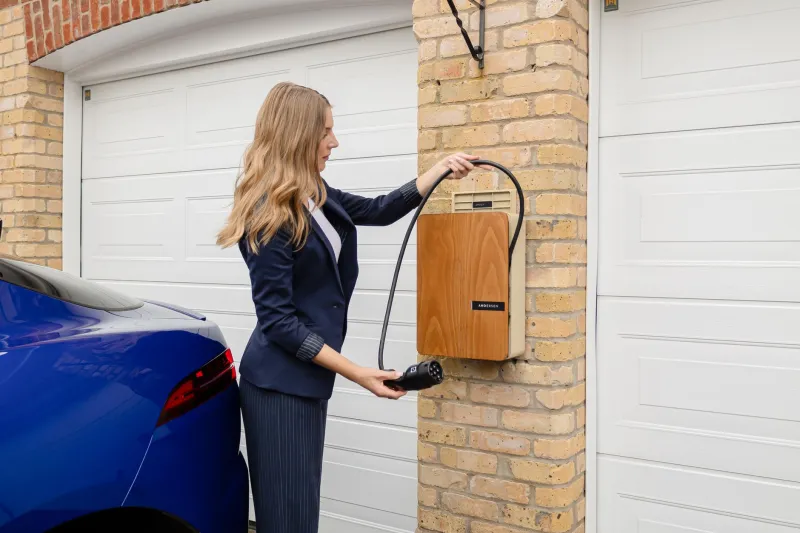
EV charger integration is currently the most mature area of home-to-vehicle connectivity. Chargers such as the Emporia Smart EV Charger, the Wallbox Pulsar Plus, and the Chargepoint Home Flex offer native integrations with Amazon Alexa, Google Home, and Apple HomeKit. Paired with a utility's time-of-use rate plan and a smart energy monitor, you can build automations that schedule charging during off-peak hours and monitor household energy consumption holistically.
Home Assistant, the open-source home automation platform, offers the most flexible path for technically inclined users. Through community-developed integrations, Home Assistant can connect with Tesla's unofficial API, Rivian's companion app, and several other manufacturer platforms. This approach requires meaningful setup effort and carries the caveat that unofficial API access can be revoked or altered by the manufacturer without notice — as Tesla demonstrated when it tightened API access in 2023.
Voice assistant routines built around departure and arrival contexts offer a simpler, if less precise, alternative. Setting a "leaving home" routine in Google Home or Alexa that locks doors, adjusts the thermostat, and activates the garage door on a scheduled or voice-triggered basis approximates some of the seamlessness of true vehicle integration without requiring any connection to the car itself.
A Realistic Timeline for True Integration
The honest answer is that meaningful, standardized home-to-vehicle integration is probably three to five years away for mainstream consumers — and that estimate is contingent on several things going right simultaneously. Matter's next major revision would need to incorporate vehicle device classes. Automakers would need sufficient competitive or regulatory pressure to open their platforms. And the cybersecurity frameworks governing both industries would need to mature enough to make cross-system control signals acceptable from a liability standpoint.
In the near term, expect incremental progress rather than a breakthrough moment. EV adoption is accelerating the conversation, because the charging relationship between a vehicle and a home's electrical system creates a natural point of integration that benefits both the automaker and the utility. That practical overlap is likely to drive more partnerships and more open APIs in the EV charging space specifically, even if broader vehicle-home integration lags behind.
The Smart Approach for Now
If you are building or refining a smart home today, the most intelligent strategy is to choose devices and platforms that already support Matter and that have demonstrated a willingness to open their APIs over time. Prioritize EV chargers with native smart home integrations. Use location-based automation where your vehicle's app permits it. And keep a close eye on Matter specification updates — because when vehicle device classes do arrive in the standard, early adopters will be positioned to benefit immediately.
The connected home and the connected car will eventually speak the same language. For now, the smartest move is understanding exactly where the translation breaks down — and working around it with the tools that are already in your hands.